
Government Contracts Lawyer
Nationwide Federal Government Contracts Lawyer – Nationwide Crisis Defense & Strategic Counsel
Emergency Response for Government Contract Crises
The call came at 4:47 PM on a Friday afternoon. Sarah Chen, CEO of a $50 million defense contracting firm, stared at her computer screen in disbelief. The contracting officer’s email was brief but devastating: “Notice of Intent to Terminate for Convenience – Effective Immediately.” Twenty years of building her company, 200 employees depending on her, and a reputation built contract by contract – all hanging in the balance because of an alleged Federal Acquisition Regulation compliance issue that she didn’t even understand.
Three states away, Marcus Rodriguez received a certified letter that would change everything. The Department of Defense was terminating his $25 million IT services contract for default, citing “material breach of performance standards.” The letter mentioned potential recovery of costs, possible debarment proceedings, and referral to the Department of Justice for investigation. Marcus had 30 days to respond, but he had no idea where to start.
Meanwhile, in Denver, Colorado, Dr. Patricia Williams opened her office Monday morning to find federal agents with search warrants and subpoenas. Her medical device manufacturing company was under investigation for alleged False Claims Act violations related to government healthcare contracts. The agents were polite but thorough, seizing computers, files, and financial records while her employees watched in stunned silence. The lead investigator handed her a business card and said, “You’ll want to call an attorney – today.”
These scenarios represent the harsh reality facing thousands of government contractors across the United States every year. When the federal government – your largest and most important client – suddenly becomes your adversary, the stakes couldn’t be higher. Criminal charges, civil penalties in the millions, suspension from all federal contracting, and the complete destruction of your business are all potential consequences of government contract disputes gone wrong.
[ “Federal government contracts attorney Theodore Watson”
T for C Termination for Convenience Government Contract Attorneys
 Theodore Watson (Former Contracting Official and U.S. Supreme Court -Admitted Attorney) leads the firm to help contractors nationwide to develop and or litigation of FAR termination for convenience decisions. He understands the various nuances and adeptly handles legal issues in the U.S. government space.
As a federal government contracts attorney with over two decades of experience defending contractors in their darkest hours, I understand that when you’re facing a government investigation, termination notice, or fraud allegation, you need more than legal advice – you need a strategic defense that protects your business, your reputation, and your freedom. At Watson & Associates, we specialize exclusively in federal cases, providing the focused expertise and emergency response capability that government contractors need when everything is on the line.
 Cheryl E. Adams (Former Contracting Officer) is an Associate Attorney with Watson and Associates, LLC. She is a former federal Contracting Officer with years of hands-on experience with all phases of federal procurement. She brings to clients an intimate understanding of the Federal Acquisition Regulation (FAR) and T for C contract FAR termination for convenience government contract clauses, as an insider perspective on the procurement processes of a federal government headquarters.
When giving termination for convenience legal representation, she understands the government’s relationships with small businesses and subcontractors, as well as relationships with Fortune 500 corporations. She has worked side by side with government auditors and personally conducted government property audits. She has handled all sizes of contract awards from micropurchases through major systems. Read more..
 Wojciech Kornacki, Of Counsel, focuses his practice on federal contract compliance, contract disputes and litigation, and business ethics. He has successfully represented dozens of private companies and individuals as a suspension and debarment lawyer facing debarment and suspension, challenged and defended contract awards at the U.S. Court of Appeals for the Federal Circuit, filed appeals and litigated claims at the Armed Services Board of Contract Appeals (ASBCA) and the Civilian Board of Contract Appeals (CBCA), drafted compliance policies and assisted in due diligence matters and training. Read more.
Robert “Bob” Ayers – Of Counsel

Wise D. Allen, Esquire – Counsel
 Wise D. Allen, Esquire, Counsel, A former Veteran Lieutenant Commander Judge Advocate for the United States Military, Wise Allen brings extensive knowledge and experience in resolving corporate defense and litigation in vast international and national legal issues.
Mr. Allen’s federal litigation experience as a former appellate attorney representing the United States and a federal white collar criminal defense attorney for defendants in trials that led to his clients receiving overwhelmingly favorable outcomes in contested issues and obtaining non-contested resolutions. Read more..
When Government Contracting Goes Wrong: Understanding Your Crisis
The federal government spends over $650 billion annually on contracts, creating a massive marketplace where opportunities and risks exist in equal measure. For the thousands of companies that depend on government contracts for their survival, a single adverse decision can trigger a cascade of consequences that threaten everything they’ve built. Understanding the most common crisis scenarios can help you recognize when you need immediate legal intervention.
Adverse Contracting Officer Decisions represent one of the most frequent triggers for contractor crises. Contracting officers wield enormous power over your business relationship with the government, and their decisions on contract interpretation, performance standards, and compliance issues can have immediate and devastating financial consequences. When a contracting officer determines that your company has failed to meet contract requirements, the government can withhold payments, demand cost recovery, or terminate your contract entirely. These decisions often come without warning and require immediate response to prevent escalation into more serious legal proceedings.
Termination for Default represents the nuclear option in government contracting disputes. Unlike termination for convenience, which allows the government to end a contract for any reason, default termination implies that your company has fundamentally failed to perform its contractual obligations. The consequences extend far beyond the immediate contract loss. Default termination can trigger automatic suspension from federal contracting, create liability for the government’s costs to complete the work with another contractor, and serve as evidence in subsequent debarment proceedings. The stigma of default termination can effectively end your company’s ability to compete for federal contracts.
Suspension and Debarment Proceedings represent the government’s most powerful enforcement tool against contractors. Suspension can be imposed immediately based on allegations alone, while debarment requires a formal proceeding but can last for years. Both actions exclude your company from all federal contracting opportunities, effectively cutting off your primary source of revenue. The government’s suspension and debarment system is designed to protect the integrity of federal procurement, but it can also be used as leverage in disputes that have little to do with actual contractor responsibility.
Government Contractor Fraud Investigations represent the most serious threat facing federal contractors today. These investigations typically begin quietly, with government auditors reviewing your contracts and billing practices. However, they can quickly escalate into criminal investigations involving federal agents, search warrants, and grand jury subpoenas. The government’s fraud enforcement efforts have intensified dramatically in recent years, with specialized task forces dedicated to prosecuting contractor fraud. Even allegations that seem minor can result in criminal charges carrying decades in prison and civil penalties that can bankrupt your company. Our government contractor fraud defense lawyers are available for immediate help.

Comprehensive Federal Government Contracts Attorney Services
As a federal government contracts attorney, I provide comprehensive legal representation through every phase of the government contracting lifecycle. From pre-award strategy and bid protests through contract performance, disputes, investigations, and enforcement actions, my practice focuses exclusively on the complex legal challenges facing government contractors. This federal specialization allows me to provide the depth of knowledge and immediate response capability that contractors need when facing government legal challenges.
Federal (COFC) Bid Protest Attorneys: Protecting Your Right to Compete
Federal bid protests represent your primary legal remedy when the government makes award decisions that violate procurement law or regulations. As federal government contracts bid protest attorneys, we represent contractors before the Court of Federal Claims, and the Court of Appeals for the Federal Circuit.
The federal bid protest process is highly technical and time-sensitive, with strict deadlines that can bar your claims if missed. Success requires a thorough understanding of procurement law, detailed knowledge of the specific solicitation requirements, and the ability to identify and articulate clear violations of federal procurement regulations.
Court of Federal Claims bid protests offer broader remedies than GAO protests, including the possibility of monetary damages for lost profits. However, federal court litigation is more expensive and time-consuming than GAO protests.
The Court of Federal Claims has jurisdiction over bid protests involving contracts exceeding $100,000, and its judges have extensive experience with complex procurement law issues. Federal procurement lawyers practicing before the Court of Federal Claims must be prepared for full litigation, including discovery, expert witnesses, and trial.
The strategic decision of which forum to choose for your bid protest can determine the success or failure of your challenge. As your federal government contracts attorneys, we analyze the specific facts of your case, the strength of your legal arguments, and your business objectives to recommend the optimal protest strategy. Time is always critical in bid protest cases, as delayed filing can result in automatic dismissal regardless of the merits of your claims.
- Construction, Architecture and Engineering (A&E)
- Defense and Aerospace
- Education
- Energy
- Environmental
- Financial Services
- Information Technology (IT), Telecommunications and Information Systems
- Intelligence Community Contractors
- GSA and VA Federal Supply Schedule Contractors
- Healthcare
- Homeland Security
- Logistics and Troop Support
- Manufacturing and Products
- Professional Services
- Real Estate
- Transportation
Government Contract Claims and Disputes: Maximizing Recovery
Government contract disputes arise from the inherent complexity of federal contracting relationships. When performance issues, scope changes, or payment disputes occur, contractors need experienced federal procurement lawyers who understand both the legal framework governing these disputes and the practical realities of government contracting. The Contract Disputes Act provides the exclusive framework for resolving most government contract disputes, but navigating this process successfully requires specialized knowledge and strategic thinking.
Requests for Equitable Adjustment (REAs) represent the contractor’s primary tool for seeking additional compensation when the government changes contract requirements or causes delays that increase performance costs. Preparing successful REAs requires detailed documentation of the changed conditions, careful analysis of the causal relationship between government actions and increased costs, and precise calculation of the additional compensation owed. Government contracting officers often deny REAs that lack sufficient documentation or fail to establish clear causation, making professional preparation essential.
Contract Disputes Act (CDA) Claims provide contractors with the right to a final decision from the contracting officer and subsequent appeal rights to either the relevant Board of Contract Appeals or the Court of Federal Claims. CDA claims against the government must be submitted in writing, include a specific monetary demand, and request a final decision from the contracting officer. The government has strict deadlines for responding to CDA claims, and contractors have appeal rights if the contracting officer denies the claim or fails to respond within the required timeframe.
Board of Contract Appeals proceedings offer specialized expertise in government contract disputes. The Armed Services Board of Contract Appeals, Civilian Board of Contract Appeals, and other agency-specific boards have judges with extensive experience in government contracting law. Board proceedings are generally faster and less expensive than federal court litigation, but they require attorneys who understand the unique procedures and precedents that govern board practice.
Federal Acquisition Regulation (FAR) Compliance: Preventing Problems

Federal Acquisition Regulation compliance represents the foundation of successful government contracting. The FAR contains thousands of pages of detailed requirements governing every aspect of the contractor-government relationship, from initial proposal submission through final contract closeout. As federal procurement lawyers, we help contractors understand and implement compliance programs that prevent violations and protect against government enforcement actions.
Cost accounting and pricing compliance under the FAR requires contractors to maintain detailed records and follow specific procedures for charging costs to government contracts. The Defense Contract Audit Agency (DCAA) conducts regular audits of contractor cost accounting systems, and audit findings can result in cost disallowances, contract modifications, or referrals for investigation. Contractors must understand the difference between allowable and unallowable costs, maintain adequate documentation for all charges, and implement internal controls that prevent inadvertent violations.
Truth in Negotiations Act (TINA) compliance requires contractors to submit cost or pricing data for certain contracts and certify that the data is accurate, complete, and current. TINA violations can result in significant financial penalties, including recovery of overpayments plus interest and penalties. The government’s TINA enforcement efforts have intensified in recent years, with specialized auditors trained to identify potential violations and recover overpayments.
Small business compliance requirements under the FAR create additional obligations for contractors participating in various small business programs. Size standard violations, affiliation issues, and compliance with subcontracting plans can result in contract termination, recovery of payments, and exclusion from future small business contracting opportunities. Federal government contracts attorneys help small business contractors navigate these complex requirements and respond to size protests and compliance challenges.
Government Contract Fraud Defense: Protecting Against Criminal Charges
Government contract fraud investigations represent the most serious threat facing federal contractors today. These investigations can result in criminal charges carrying decades in prison, civil penalties in the millions of dollars, and permanent exclusion from federal contracting. As a federal government contracts attorney specializing in fraud defense, I provide immediate response to government investigations and aggressive defense against criminal and civil enforcement actions.
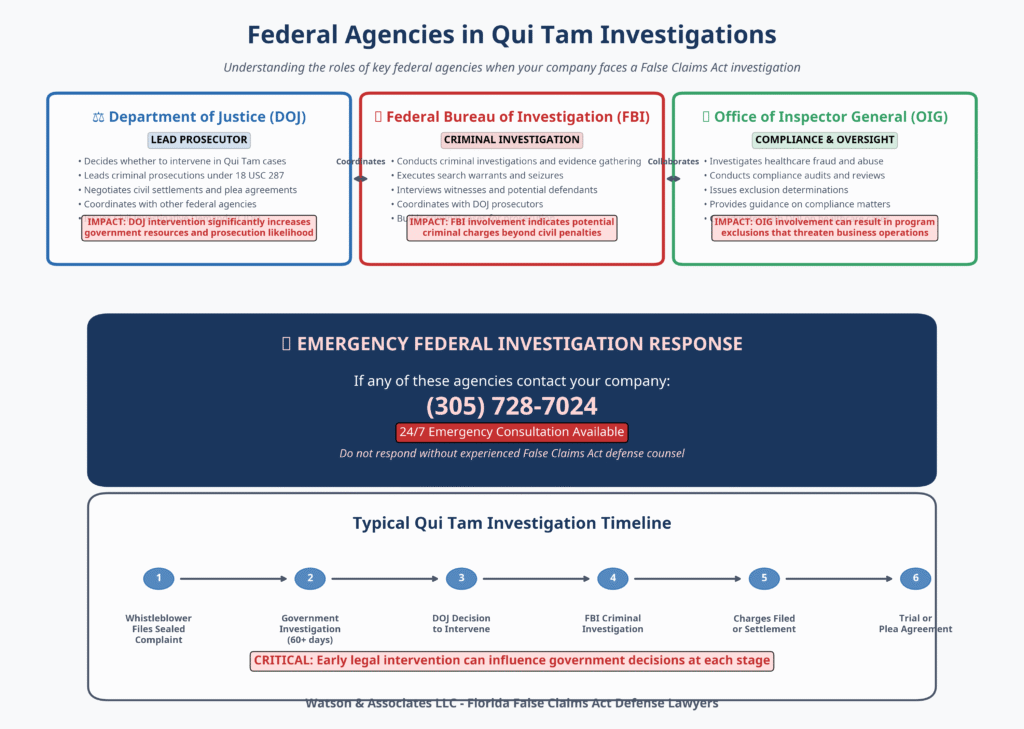
The False Claims Act represents the government’s primary tool for pursuing civil fraud cases against government contractors. FCA violations can result in treble damages plus civil penalties of up to $23,607 per false claim. The government’s FCA enforcement efforts have recovered over $70 billion since 1986, with healthcare and defense contractors representing the largest sources of recoveries. FCA cases often begin with whistleblower complaints filed under the Act’s qui tam provisions, allowing private parties to file lawsuits on behalf of the government and share in any recovery.
Criminal fraud prosecutions under 18 U.S.C. § 1341 (mail fraud), 18 U.S.C. § 1343 (wire fraud), and 18 U.S.C. § 371 (conspiracy) can result in up to 20 years in prison for each count. The government’s contractor fraud task forces include experienced prosecutors, FBI agents, and auditors who specialize in complex financial investigations. These investigations often involve extensive document review, witness interviews, and forensic accounting analysis designed to build criminal cases against contractor executives and employees.
The Major Fraud Act, 18 U.S.C. § 1031, specifically targets fraud in government contracting and carries enhanced penalties for cases involving contracts exceeding $1 million. Major Fraud Act prosecutions can result in up to 10 years in prison and fines up to $1 million or twice the gross gain or loss from the offense. The government often uses the Major Fraud Act in cases involving defense contractors, where the national security implications of fraud are considered particularly serious.
Procurement Integrity Act violations can result in both criminal and civil penalties for contractors who improperly obtain or use government procurement information. The Act prohibits contractors from seeking or obtaining proprietary information about competitors’ bids and restricts the employment of former government officials who were involved in the procurement process. PIA violations can result in contract cancellation, civil penalties, and criminal prosecution.
Suspension and Debarment Defense: Protecting Your Right to Contract
 Suspension and debarment proceedings represent the government’s most powerful enforcement tool against contractors. These administrative actions can exclude your company from all federal contracting opportunities, effectively ending your business if government contracts represent a significant portion of your revenue. As a federal government contracts attorney specializing in suspension and debarment defense, I help contractors respond to show cause notices, develop corrective action plans, and negotiate administrative agreements that allow continued participation in federal contracting.
Suspension can be imposed immediately by any federal agency based on allegations of wrongdoing, without a formal hearing or finding of liability. The suspension remains in effect pending the completion of legal proceedings or until the suspending official determines that the cause for suspension has been resolved. Suspension is supposed to be a temporary measure to protect the government’s interests, but it can last for years while criminal or civil cases proceed through the courts.
Debarment requires a formal proceeding with notice and an opportunity to respond, but it can last for up to three years and can be extended in cases involving ongoing criminal conduct. Debarment is based on a finding that the contractor lacks present responsibility to perform government contracts, considering factors such as the seriousness of the conduct, the contractor’s response to the allegations, and the adequacy of any corrective measures implemented.
The government’s suspension and debarment system is designed to be remedial rather than punitive, focusing on protecting the government’s interests rather than punishing contractors for past misconduct. This remedial focus creates opportunities for contractors to avoid or minimize exclusion by demonstrating present responsibility through corrective actions, compliance programs, and other measures that address the government’s concerns.
Administrative agreements represent an alternative to formal suspension or debarment proceedings, allowing contractors to continue participating in federal contracting while implementing specific compliance measures. These agreements typically include requirements for enhanced compliance programs, regular reporting to the government, and ongoing monitoring by independent compliance monitors. While administrative agreements can be burdensome and expensive, they allow contractors to maintain their federal contracting eligibility while addressing the government’s concerns.
Government Contractor Investigations: Immediate Response Strategy
Government contractor investigations can begin quietly with routine audits but can quickly escalate into criminal investigations involving federal agents, search warrants, and grand jury subpoenas. When your company becomes the target of a government investigation, an immediate response is essential to protect your legal rights and minimize potential exposure. As your federal government contracts attorneys, we provide 24/7 emergency response to government investigations and coordinate all aspects of your legal defense.
Internal investigations often precede formal government action and provide an opportunity to identify and address potential problems before they become the subject of government enforcement actions. When conducted properly under attorney-client privilege, internal investigations can help you understand the scope of potential exposure, preserve relevant documents, and develop a strategy for responding to government inquiries. However, internal investigations must be carefully managed to avoid creating additional evidence that could be used against your company.
Document preservation is critical when facing any government investigation. Federal law requires contractors to preserve all documents that might be relevant to the investigation, including electronic communications, financial records, and internal reports. Failure to preserve documents can result in separate obstruction of justice charges and adverse inferences in civil proceedings. Implementing a litigation hold and ensuring that all employees understand their document preservation obligations is essential.
Grand jury investigations represent the most serious form of government investigation, as they indicate that prosecutors are considering criminal charges. Grand jury subpoenas require the production of documents and testimony under oath, and the grand jury process is conducted in secret with no right to counsel for witnesses. Responding to grand jury subpoenas requires careful coordination with experienced federal government contracts attorneys who understand the criminal justice process and can protect your rights while cooperating with the investigation.
START DEFENDING YOUR CASE NOW — Speak with a Federal Defense Lawyer Today
SBA Small Business Matters: Protecting Your Competitive Advantages
Small Business Administration programs provide significant competitive advantages for qualifying contractors, including set-aside contracts, sole-source awards, and subcontracting opportunities. However, these programs also create complex compliance obligations and expose contractors to size protests, eligibility challenges, and SBA investigations. As federal procurement lawyers specializing in SBA matters, we help small business contractors maximize their competitive advantages while maintaining compliance with program requirements.
SBA Size protests represent the most common challenge facing small business contractors. Competitors can protest your size status for any specific procurement, and the SBA’s size determination can affect not only the protested contract but also your eligibility for future small business opportunities. Size protests often involve complex affiliation analyses, considering factors such as ownership relationships, management control, and contractual arrangements that might create affiliation between otherwise separate entities.
8(a) Program compliance requires participating contractors to maintain their eligibility throughout the nine-year program term while meeting specific business development requirements. The SBA conducts annual reviews of 8(a) participants and can terminate companies that fail to maintain eligibility or meet program requirements. 8(a) termination can result in the loss of existing contracts and exclusion from future 8(a) opportunities.
HUBZone certification provides access to set-aside contracts for businesses located in Historically Underutilized Business Zones, but maintaining certification requires ongoing compliance with location and employee residency requirements. The SBA conducts regular recertification reviews and can decertify companies that fail to maintain their HUBZone status. HUBZone decertification can result in contract termination and recovery of payments received under HUBZone contracts.
Service-Disabled Veteran-Owned Small Business (SDVOSB) and Veteran-Owned Small Business (VOSB) programs provide contracting opportunities for veteran entrepreneurs, but they also create specific eligibility requirements related to ownership, control, and management by qualifying veterans. The Department of Veterans Affairs has its own verification program for SDVOSB and VOSB contractors, and VA verification is required for VA contracts and can provide competitive advantages for other federal contracts.
Federal Procurement Compliance: Staying Ahead of Regulatory Changes
Federal procurement compliance requires ongoing attention to regulatory changes, policy updates, and evolving government expectations. The Federal Acquisition Regulation is updated regularly, and contractors must stay current with changes that affect their compliance obligations. As federal government contracts attorneys, we help contractors implement compliance programs that adapt to regulatory changes and protect against government enforcement actions.
Cybersecurity compliance has become increasingly important for government contractors, with new requirements under the Defense Federal Acquisition Regulation Supplement (DFARS) and the Cybersecurity Maturity Model Certification (CMMC) program. These requirements mandate specific cybersecurity controls for contractors handling controlled unclassified information (CUI) and require third-party certification for many defense contracts. Cybersecurity compliance failures can result in contract termination, civil penalties, and criminal prosecution.
Trade Agreements Act compliance requires contractors to ensure that products supplied under government contracts are manufactured in designated countries or qualify for specific exceptions. TAA violations can result in contract termination, cost recovery, and exclusion from future contracting opportunities. The government’s TAA enforcement efforts often focus on contractors in industries with significant foreign manufacturing, such as information technology and textiles.
Why Choose Watson & Associates: Federal Specialization Advantage
When your company faces a government contracting crisis, the attorney you choose can determine whether you survive and thrive or face devastating consequences that destroy your business. Large law firms may have impressive credentials and extensive resources, but they typically handle government contracts as just one practice area among many. At Watson & Associates, we focus exclusively on federal government contracts, providing the specialized knowledge and immediate response capability that contractors need when everything is on the line.
Federal Cases Only represents our fundamental competitive advantage. While our competitors handle state and local procurement, commercial litigation, and other practice areas, we concentrate exclusively on federal government contracting law. This specialization allows us to stay current with the latest developments in federal procurement law, maintain relationships with key government officials, and develop the deep expertise that comes from handling hundreds of federal contracting cases.
24/7 Emergency Response sets us apart from traditional law firms that operate on standard business hours. Government investigations don’t wait for convenient timing, and contracting officer decisions often come with immediate deadlines that require instant response. When federal agents arrive at your facility with search warrants, when you receive a termination notice on Friday afternoon, or when a suspension notice threatens to shut down your business, you need immediate access to experienced federal government contracts attorneys who understand the urgency of your situation.
Washington DC and Denver Strategic Locations provide us with direct access to the federal agencies, courts, and officials who control your contracting fate. Our Washington DC office is located minutes from the major federal agencies, allowing us to meet with government officials, attend hearings, and respond to emergencies without the delays and expenses associated with travel from distant locations. Our Denver office provides similar access to western federal agencies and courts while serving contractors throughout the mountain west region.
Former Government Attorney Experience gives us unique insights into how government agencies think, operate, and make decisions. Having worked inside the federal government, we understand the pressures facing contracting officers, the priorities of government attorneys, and the factors that influence government decision-making. This insider knowledge allows us to develop strategies that address the government’s real concerns rather than simply arguing legal technicalities.
Boutique Firm Advantages mean that your case receives personal attention from experienced attorneys rather than being delegated to junior associates or contract attorneys. At large firms, government contracts work is often handled by attorneys who divide their time between multiple practice areas and may lack the focused expertise that complex federal contracting cases require. Our boutique structure ensures that every client works directly with experienced federal government contracts attorneys who understand their business and their legal challenges.
Frequently Asked Questions: Government Contracts Legal Issues
What should I do immediately if I receive a government investigation notice?
 The first 24 hours after receiving a government investigation notice are critical to protecting your legal rights and minimizing potential exposure. Contact an experienced federal government contracts attorney immediately, even before responding to any government requests for information or interviews. Implement a litigation hold to preserve all relevant documents, including electronic communications and financial records. Do not discuss the investigation with employees or third parties beyond what is necessary to preserve documents and protect legal rights. Avoid making any statements to government investigators without legal counsel present, as anything you say can be used against you in subsequent proceedings.
How much does a federal government contracts attorney cost?
Legal fees for government contracts matters vary significantly based on the complexity of the case, the urgency of the situation, and the potential exposure involved. Emergency response services for government investigations typically require immediate engagement with hourly rates ranging from $500 to $800 per hour for experienced federal government contracts attorneys. Complex litigation matters such as bid protests or Contract Disputes Act claims may be handled on either an hourly or contingency fee basis, depending on the circumstances. Many contractors find that investing in experienced legal counsel early in a dispute can prevent much larger costs associated with prolonged litigation, civil penalties, or criminal prosecution.
What are the potential penalties for government contract fraud?
Government contract fraud penalties can be devastating, including both criminal and civil consequences that can destroy your business and result in decades in prison. Criminal penalties under federal fraud statutes can include up to 20 years in prison for each count of mail or wire fraud, fines up to $250,000 per count, and restitution for the full amount of losses. Civil penalties under the False Claims Act can include treble damages plus civil penalties up to $23,607 per false claim, which can result in total penalties many times the original contract value. Administrative penalties can include suspension or debarment from all federal contracting, effectively ending your business if government contracts represent a significant portion of your revenue.
How long do government contract disputes typically take to resolve?
The timeline for resolving government contract disputes varies significantly based on the forum chosen and the complexity of the issues involved. GAO bid protests must be resolved within 100 days of filing, making them the fastest option for challenging procurement decisions. Board of Contract Appeals cases typically take 12 to 18 months from filing to decision, though complex cases can take longer. Court of Federal Claims litigation can take two to three years or more, particularly if the case involves extensive discovery and expert testimony. Settlement negotiations can resolve cases more quickly, but they require experienced federal procurement lawyers who understand the government’s priorities and decision-making process.
Can I continue operating my business during a government investigation?
In most cases, you can continue operating your business during a government investigation, but you must be extremely careful to avoid any actions that could be construed as obstruction of justice or continued violations. Implement a comprehensive document preservation program to ensure that no relevant evidence is destroyed. Avoid discussing the investigation with employees beyond what is necessary to preserve documents and protect legal rights. Consider conducting an internal investigation under attorney-client privilege to identify potential problems and develop a response strategy. Consult with experienced federal government contracts attorneys before making any significant business decisions that could affect the investigation or your legal exposure.
What is the difference between suspension and debarment?
Suspension is an immediate exclusion from federal contracting that can be imposed based on allegations alone, without a formal hearing or finding of liability. Suspension is supposed to be temporary, lasting only until legal proceedings are completed or the cause for suspension is resolved, but it can continue for years while criminal or civil cases proceed through the courts. Debarment requires a formal proceeding with notice and an opportunity to respond, but it can last for up to three years and is based on a finding that the contractor lacks present responsibility to perform government contracts. Both suspension and debarment exclude contractors from all federal contracting opportunities, but debarment is considered more serious and can be more difficult to overcome.
How should I respond to a contracting officer’s adverse decision?
Responding to an adverse contracting officer decision requires immediate action to protect your legal rights and preserve your appeal options. Review the decision carefully to understand the contracting officer’s reasoning and identify any factual or legal errors. Determine whether you have grounds for a Contract Disputes Act claim, which must be submitted in writing with a specific monetary demand and a request for a final decision. Consider whether the decision affects other contracts or your overall relationship with the government agency. Consult with experienced federal government contracts attorneys to evaluate your legal options and develop a response strategy that protects your business interests while maintaining your relationship with the government.
What are my rights during a government audit?
Government contractors have specific rights during audits, but they also have obligations to cooperate with legitimate audit requests. You have the right to have legal counsel present during audit interviews and to review audit findings before they become final. You can challenge audit findings that you believe are incorrect and request reconsideration of adverse determinations. However, you also have an obligation to provide access to relevant records and to cooperate with reasonable audit requests. Attempting to obstruct or interfere with a legitimate audit can result in separate legal violations and can escalate a routine audit into a criminal investigation.
Emergency Response: When Every Hour Counts
Government contracting crises don’t follow business hours, and the first 24 hours after receiving adverse government action can determine the ultimate outcome of your case. Whether you’re facing a termination notice, investigation subpoena, or suspension order, immediate response by experienced federal government contracts attorneys can mean the difference between protecting your business and facing devastating consequences.
Immediate Crisis Response Services are available 24 hours a day, seven days a week, because government emergencies don’t wait for convenient timing. When federal agents arrive at your facility with search warrants, when you receive a default termination notice on Friday afternoon, or when a suspension order threatens to shut down your business over the weekend, you need immediate access to attorneys who understand the urgency of your situation and can take immediate action to protect your rights.
Document Preservation and Litigation Hold Implementation must begin immediately when any government investigation or legal proceeding becomes known or reasonably anticipated. Federal law requires contractors to preserve all documents that might be relevant to the proceeding, and failure to preserve documents can result in separate obstruction of justice charges and adverse inferences in civil proceedings. Our emergency response team can help you implement a comprehensive litigation hold within hours of learning about potential legal exposure.
Government Agency Communication and Negotiation often determines whether a crisis escalates into formal enforcement action or can be resolved through cooperation and corrective measures. The first communications with government officials set the tone for the entire proceeding and can significantly influence the government’s approach to your case. Our attorneys have extensive experience communicating with federal agencies and can help you respond appropriately to government inquiries while protecting your legal rights.
Strategic Crisis Management involves coordinating legal, business, and public relations responses to minimize the impact of government action on your operations, reputation, and relationships. Government contracting crises often become public through press releases, court filings, or industry publications, and managing the public narrative can be as important as managing the legal response. Our crisis management approach considers all aspects of your situation and develops a comprehensive strategy that protects your business interests.
Contact Watson & Associates: Your Federal Contracts Defense Team
When your company faces a government contracting crisis, every hour counts. The decisions you make in the first 24 hours after receiving adverse government action can determine whether you protect your business or face devastating consequences that threaten your survival. Don’t face the federal government alone – contact Watson & Associates immediately for emergency consultation and strategic defense.
24/7 Emergency Consultation Hotline: (866) 601-5518
Our emergency response team is available around the clock to provide immediate consultation and begin developing your defense strategy. Whether you’re facing a government investigation, contract termination, or enforcement action, we can provide immediate guidance and take action to protect your rights.
Free Initial Consultation for Government Contracts Matters
We understand that government contracting crises create immediate financial pressure, and we offer free initial consultations to help you understand your legal options and the potential consequences of government action. During your consultation, we’ll review the specific facts of your situation, explain your legal rights and options, and provide an honest assessment of your case.
START DEFENDING YOUR CASE NOW — Speak with a Federal Defense Lawyer Today
For Immediate Help, Call our Government Contracts lawyers at 1.866.601.5518, or contact us online for a Free Initial Consultation.